Sunday, March 31, 2024

Digital Resources Frank Lloyd Wright's Hollyhock House, Los Angeles

hollyhock house

In 2007, the City and Project Restore, a public-private partnership, began planning a project to address structural needs and restoration. In 2010, the project team began four years of work to repair and prevent water damage, seismically strengthen the house, restore historic elements, and reverse past alterations. Built between 1919 and 1921, Hollyhock House was the first Los Angeles commission for the legendary architect Frank Lloyd Wright.

HOLLYHOCK HOUSE

Oil heiress Aline Barnsdall commissioned the house as the centerpiece of a cultural arts complex on Olive Hill, which was to include a major theatre, cinema, artist residences, and commercial shops. For Hollyhock House, her personal residence, Barnsdall asked Wright to incorporate her favorite flower, the hollyhock, into the design. In 1927, Barnsdall donated the house and the surrounding 12 acres (now Barnsdall Park) to the City of Los Angeles. Today, Hollyhock House is owned and operated by the Department of Cultural Affairs (DCA). Yet it was renovated several times, had long suffered from water intrusion, and was damaged in the 1994 Northridge earthquake.

The Gardens and Landscapes of Frank Lloyd Wright - Larchmont Buzz

The Gardens and Landscapes of Frank Lloyd Wright.

Posted: Mon, 01 Apr 2024 07:00:00 GMT [source]

Who was Aline Barnsdall?

A passionate supporter of the arts, she was a stage producer—earning critical acclaim for her avante-garde productions for children and adults alike in Chicago, New York, and Los Angeles (while awaiting a Wright-designed theater that never came). In 1919, she purchased Olive Hill, a 36-acre mount on Hollywood’s eastern edge and far north of downtown Los Angeles. With the site secured, the commission grew to include plans for the theater, a cinema, artist residences, commercial shops, two guest houses, and a residence for Barnsdall.

Hollyhock House added to World Heritage List

Frank Lloyd Wright's Hollyhock House unites fire, earth, air, water - KCRW

Frank Lloyd Wright's Hollyhock House unites fire, earth, air, water.

Posted: Thu, 04 Aug 2022 07:00:00 GMT [source]

He designed it for Aline Barnsdall, a wealthy iconoclast and patron of the arts (learn more about her here). Barnsdall envisioned the house as the centerpiece of an artists’ colony on Olive Hill in the neighborhood of Los Feliz. Hollyhock House was designed by America’s most important 20th-century architect, Frank Lloyd Wright. Aline Barnsdall was also a philanthropist and in 1927 gave the house and the surrounding twelve acres atop Olive Hill (now Barnsdall Park) to the City of Los Angeles as a memorial to her father Theodore. With project delays and cost overruns, he then left the project only partially realized. Within a few years, Barnsdall began to consider gifting the house and surrounding parklands to the City of Los Angeles.

Friends of Hollyhock House (FOHH)

hollyhock house

She never questioned the beauty or significance of Wright’s work on Olive Hill, but with early leaks and no theater to speak of, the house had lost its luster for Barnsdall. She did, however, reengage with Wright on numerous occasions after 1921, enlisting him to design a school house for the property as well as preliminary plans for another residence in Beverly Hills; neither were realized. In 1915, Aline Barnsdall, an oil heiress, first approached Frank Lloyd Wright not to build a house but a theater.

A Brief Tour of the Hollyhock House
hollyhock house

100 years after Frank Lloyd Wright finished construction on Aline Barnsdall’s Residence A guest house, the City of Los Angeles has concluded phase I restoration of this landmark structure. The first video provides an overview from the project team, discussing the home’s significance, what’s been done in phase I, and what work is still to come. Barnsdall bought Olive Hill in 1919 from the widow of the man who had planted the olive trees. Wright eventually came up with grand plans that suited Barnsdall's theatricality, although she and her daughter never lived in the house that Wright built.

Get our monthly email updates on what’s happening in Los Angeles County

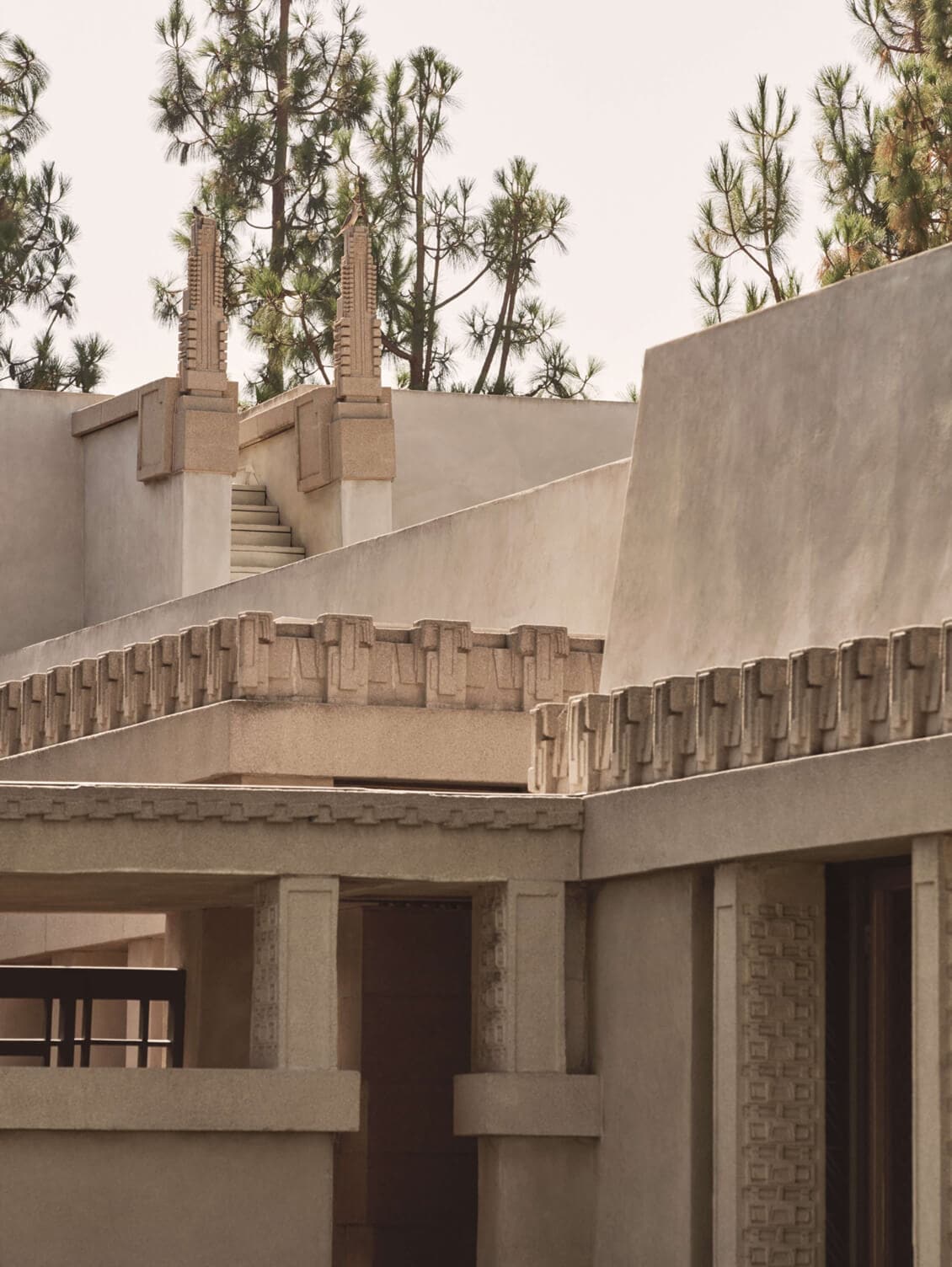
For Hollyhock House, Barnsdall asked Wright to incorporate her favorite flower, the hollyhock, into the home’s design. As with many of Wright's residences, Hollyhock House has an "introverted" exterior with windows that seem hidden from the outside, and is not easy to decode from the outside. The house is arranged around a central courtyard with one side open to form a kind of theatrical stage (never used as such), and a complex system of split levels, steps and roof terraces around that courtyard.

Barnsdall Art Park on Olive Hill in Hollywood, California is now owned and run by the City of Los Angeles. The City of Los Angeles is home to many architectural treasures, none more intriguing than Hollyhock House. The Department of Cultural Affairs manages this and four other entities in Barnsdall Art Park, but the focus of this photo journey is on Hollyhock House. Built between 1919 and 1921, the house realized by Wright for Louise Aline Barnsdall is an architectural experiment among landscaped gardens, hardscaped pools, and galleries of art on Olive Hill.

Water is meant to flow from a pool in the courtyard through a tunnel to this inside moat, and out again to a fountain. Disillusioned by the costs of construction and maintenance, Barnsdall donated the house to the city of Los Angeles in 1927[8] under the stipulation that a fifteen-year lease be given to the California Art Club for its headquarters. The club was there until 1942 when the house was almost demolished.[9] The house has been used as an art gallery and as a United Service Organizations (USO) facility over the years. Beginning in 1974, the city sponsored a series of restorations, but the structure was damaged in the 1994 Northridge earthquake.


A Philosophy of Software Design: My Take and a Book Review The Pragmatic Engineer

a philosophy of software design

In chapter 20, the author addresses the topic of performance optimizations. He says that if you try to optimize every statement for maximum speed, it will slow down development and create complexity. Still, if you ignore performance, it is easy to create a system with significant inefficiencies through the code (called the “death by a thousand cuts” scenario). The solution is in the middle, so we design things that are “naturally efficient” but also clean and simple to know which operations are expensive.

iv. All the comments I have seen are worthless

By this the author means that the interface should be general enough to support multiple implementations, even though the implementation only covers what is needed today. Reducing the API to a few general purpose methods instead of many special purpose will do this and make the module deep. An example for an interactive text editor is given, where several functions, like delete, backspace, deleteSelection etc, were replaced by the more general purpose functions insert and delete. This resulted in clearer division of functionality, as well as a simplified interface. Calling out event-driven programming as something that makes the code less obvious (Chapter 18) is an interesting take, that I would have hesitated to phrase as such.

Leave a comment Cancel reply

a philosophy of software design

Any change to the sender usually also requires a change to the receiver. An example is if you add a new exception, and you then also need to add a new entry in an error message table, but the connection between them is not obvious. IEEE Software presents pioneering ideas, expert analysis, and thoughtful insights for software professionals who need to keep up with rapid technology change. The book does leave a glaring gap on testing and how testability and good architecture go hand in hand. I would recommend a book like Clean Code or Working Effectively with Legacy Code to augment the topics written here.

Chapter 19 — Software Trends

If all special cases can be excluded at the beginning, no checks are needed after that. Maybe all the data needed could be combined in a single data structure. The next step is to rearrange the code to be optimized to get as close as possible to this ideal case. A connection with previous chapters is that deep modules are more efficient than shallow, since more work is done for each method call.

This book discusses how to decompose complex software systems into modules that can be implemented relatively independently. The discussion first begins with a fundamental problem in software design, managing complexity. It then discusses philosophical issues about how to approach the software design process, and it presents a collection of design principles to apply during software design. The benefit of using the interface rather than the implementation directly is not very big, so it doesn’t help in reducing the complexity of the system. It is interesting that this is the complete opposite of the advice in for example Clean Code. There the mantra is to use many small classes and methods, rather than a few bigger ones.

Everything that is discussed in the book is at a fairly general and high-level, but it's still very helpful. As developers, we ultimately owe to ourselves to ensure we reduce complexity. The by-product of reducing complexity for ourselves is that we develop better products for our users. Furthermore, when you work in a codebase, you can easily navigate in and out of methods. In these cases, a comment describing what a method does doesn’t help much.

When developing a module, look for opportunities to take a little bit of extra suffering upon yourself in order to reduce the suffering of your users. The simplest chapter abstracting the deeper complexities of what it means! It would also have been interesting if the author had included something about testing and how to write code that is easy to test.

Names should be precise (you usually want to avoid overly-general names likedata), and consistent - if a name is used in multiple places it should refer tothe same thing. If the same name is used to refer to different concepts, then atsome point a reader will be confused, which is likely to introduce errors to theprogram. This is not always bad - the important thing is that each new method shouldcontribute significant functionality. For example, a dispatcher method is apass-through method that can be very useful. Once a codebase gets complex enough, it is nearly impossible to fix, and youwill probably pay high development costs for the rest of its life. I have to be honest, that is exactly how I approached this problem initially.

Event-driven programming makes code less obvious

We can do this by masking exceptions by detecting and handling them at a low level or aggregating them in a single piece of code at a higher level. What we usually see with startups is pressure to build products quickly, which can result in spaghetti code. One of those is to hire great people who like to work with high-quality codebases. In addition, we need to make our development 10-20% slower, and you will get it all back in the future (this also reduces tech debt).

For the benefit of people who already purchased the First Edition, I have made the two new chapters and the comparisons with Clean Code available in a book extract. It may not be worth buying the Second Edition if you already own the First Edition. Overall, I'm largely in agreement with Ousterhout and with your own assessment of his book. With respect, we disagree somewhat about things you question Ousterhout's text. Complexity is anything related to the structure of a software system that makes it hard to understand and modify the system.

And in the best modules, the deep functionality is hidden behind a simple interface. If we think about the most complex problems in Computer Science, there are different thoughts on this. Where you must handle exceptions, you should prefer to handle many exceptionswith a single piece of code. There are two main ways to handle exceptions, each with their owncomplexity. The first is to complete the work in spite of the exception, and thesecond is to report the exception upwards (perhaps also running some unwinding /handling logic).

The author makes a solid case against classitis – the compulsion (particularly in the Java community) to split everything into a new class.

What Is DevOps: A Guide to DevOps Benefits, Tools and More - BizTech Magazine

What Is DevOps: A Guide to DevOps Benefits, Tools and More.

Posted: Fri, 30 Apr 2021 07:00:00 GMT [source]

The author is a professor of Computer Science at Stanford, but he has also spent 14 years developing commercial software. John Ousterhout, professor of computer science at Stanford University, joined SE Radio host Jeff Doolittle for a conversation about his book, A Philosophy of Software Design (Yaknyam Press). They discuss the history and ongoing challenges of software system design, especially the nature of complexity and the difficulties in handling it. The conversation also explores various design concepts from the book, including modularity, layering, abstraction, information hiding, maintainability, and readability. By encapsulating complexity via modular design and making code simple and obvious, like eliminating special cases or using consistent coding styles.

You still often need to check the details of the code to know that your change will be correct. The problem with comments is that they can get out of sync with the code, and that they clog up the code. In most cases, well-chosen names for methods and variables makes comments unnecessary. If the code is so complicated that it needs to be explained with comments, perhaps it can be rewritten to make it clearer.

Saturday, March 30, 2024

Book Review: A Philosophy of Software Design

a philosophy of software design

Complexity makes it more difficult for a programmer to understandand change software, it increases the rate of errors, it slows developmentvelocity, and has other negative affects. I agree with the notion that if there are tricky aspects of the code that are not obvious from reading it, then you should write a comment. There are also two good examples on pages 118 and 119 on how to write comments for cross-module design decisions. In the scripting language Tcl that the author created, the unset instruction removes a variable.

Recommendations I don't necessarily agree with

I'm currently engaged in developing a prototype of what is going to be an extremely large software application, which tackles a multitude of complex tasks and issues. As an engineering manager, I strongly advocate and sometimes even insist on designing systems twice or even three times. Note that this is a countrary suggestion to the one from the “Clean code” book of Uncle Bob Martin. Here are some things that I found valuable in this book, and they are located primarily in chapters 2 to 11. You'll end up with a much better result if you consider multiple options foreach major design decision.

a philosophy of software design

TDD focuses on features rather than abstractions and design

The functionality could have been provided by just one such class, reducing the boilerplate code needed. Furthermore, commonly needed features, such as buffered I/O, should be the default behavior, with extra parameters or setup only needed when it isn’t the common case. A Philosophy of Software Design is a well-written book with many good and practical ideas on how to reduce complexity to make systems easier to understand and work with. There are good examples illustrating the various techniques, and the writing is clear and concise.

Chapter 2 — The Nature of Complexity

A larger service that is cohesive results in less complexity than several smaller services, manipulating the same data source. But by splitting into new classes, you’re driving toward shallow modules. My own thought on this is that in order to write and work with high-qualitycomments, you need to be at a certain level of fluency.

An example is from the text editor, where sometimes text is selected, sometimes no text is selected. Using a boolean to explicitly keep track of if there is a selection or not leads to lots of special handling. Instead, if you allow an empty selection of zero characters, there is no need for special handling. It is compact and short, only 170 pages, so it is a quick read, but it contains many good ideas. The focus is on how to structure systems to make them easy to understand and work with.

This modular approach promotes reusability, scalability, and ease of maintenance. Additionally, adopting the principle of separation of concerns allows developers to isolate different aspects of the software, ensuring that each module focuses on its designated responsibility. A fundamental principle of software design philosophy is simplicity. Keeping software designs simple and minimalistic helps in reducing complexity, improving readability, and enhancing maintainability. By avoiding unnecessary complexity, developers can create software that is more manageable, adaptable, and less prone to errors.

John argues that exceptions introduce one of the worst sources of complexity and advocates for writing code that needs no exceptions to run. This is a section that seems to build on John's own experience, and him analyzing Windows APIs and does not bring classroom examples. Software design philosophy emphasizes the importance of designing software with flexibility and extensibility in mind. Building software systems that can adapt to changing requirements or accommodate new features is crucial for long-term success. Developers achieve this by designing software with well-defined interfaces, using design patterns, and applying modular and decoupled architectures. Flexible and extensible designs allow software to evolve and grow without requiring significant rework or disruption.

Meet a Worldliner: Luke, Software Engineer, New Zealand - Worldline

Meet a Worldliner: Luke, Software Engineer, New Zealand.

Posted: Thu, 13 Jul 2023 07:00:00 GMT [source]

The chapter ends with a good example from the RAMCloud system, where this thinking is applied to buffer allocation code, for a speed-up of a factor of two for the most common operation. Finally, also somewhat related to deep modules, is the idea that different layers should use different abstractions. For example in TCP, the top level abstraction is that of a stream of bytes. The lower level uses an abstraction of packets that can be lost or reordered. If adjacent layers contain the same or very similar abstractions, perhaps they should be combined to create a deeper module. A sign that this is the case is that there are pass-through methods – methods that does little more than calling other methods with the same or very similar signatures.

Rules of thumb, laws, guidelines and principles

a philosophy of software design

Fundamental optimizations typically obtain the most significant optimization improvements. For instance, it can modify the data structure or algorithm or add a cache. To optimize the code and come as near to this ideal condition as feasible, the next step is to reorder it. In Chapter 11, the author considered a perfect way of thinking about designing software, and that is trade-offs. It is doubtful that you will produce the best design from your first thoughts about it, but it would be much better to have multiple options to choose from and analyze which one is the best for your case. Event-driven programming makes it hard to follow the flow of control.

This is my summary and notes from A Philosophy of Software Design, 2nd Edition by John Ousterhout. Please use the link if you decide to buy the book after reading this as it contains my affiliate code. This doesn't mean that there is no use-case for event-driven programming, butcare should be taken to mitigate this complexity.

In this article, we explore the philosophy of software design and its importance in the development process. Each piece of design infrastructure added to a system, such as an interface, argument, function, class, or definition, adds complexity, since developers must learn about this element. In order for an element to provide a net gain against complexity, it must eliminate some complexity that would be present in the absence of the design element.

Shop All Hair Care

Table Of Content Services Overview Due to inactivity, you will besigned out in approximately: Zacks Research is Reported On: Unique Zacks An...